


If you think the same way, you will probably just keep waiting. If you are finding it difficult to invest now, you will find it even more difficult to invest if the markets run up even further. If the markets were to go down, you will probably wait for even lower levels.
What do you do?
Dynamic Asset Allocation funds could be an answer for such investors.
How do Dynamic Asset Allocation Funds work?
A dynamic asset allocation fund, in principle, reduces exposure to equity when the market valuation is high and increases exposure when the market valuation is low. Hence, such funds work on the principle of buying low and selling high.
Thus, such funds increase allocation to equity when markets are low and increase exposure to debt when equity markets are high.
Unlike balanced funds, dynamic asset allocation funds do not keep a floor on equity exposure at 65% of the total assets. Depending upon market conditions, the fund manager can reduce equity exposure much below 65% and may go to as low as 0%.
Each dynamic asset allocation fund may have a different metric of assessing market valuation levels. A few funds use index PE levels while others use P/BV level. There is a fund which uses yield gap to assess market levels.
How are Dynamic asset Allocation funds taxed?
A few dynamic allocation funds operate as Fund of Funds (FoF), which gets tax treatment of a debt fund.
To counter this, a few funds invest directly in equities. To get tax treatment of an equity fund, the fund manager needs to maintain a minimum equity exposure of 65%.
Hence, a few funds that take exposure to direct equity may not qualify as equity funds from the perspective of taxation.
Again, a few funds use derivative strategies to qualify as equity funds in the eyes of income tax department. For instance, in case of ICICI Prudential Balanced Advantage Fund, the direct equity exposure does not go below 65%, thereby ensuring tax treatment as an equity fund. To reduce net equity exposure below 65%, the fund shorts index futures.
How about the performance of Dynamic Asset Allocation Funds?
Let’s compare the performance of a dynamic asset allocation fund with other fund schemes from the same fund house.
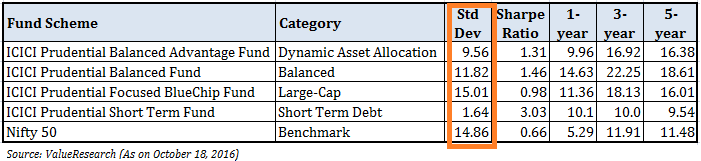

Focus on the standard deviation, a measure of volatility. Expectedly, a pure debt fund has the lowest standard deviation.
In case of funds with exposure to equity, ICICI Prudential Balanced Advantage Fund has the lowest standard deviation. However, you can also see that the returns are also lower as compared to Balanced Fund and Focused Blue Chip Fund for 1-year and 3-year horizons.Focus on the standard deviation, a measure of volatility. It is expectedly the lowest for a pure debt fund.
With dynamic asset allocation funds, the intent is to lower volatility. Lower volatility may result in a gentler market experience for the investors.
Do note above image is merely a snapshot of performance in time. Rolling return is a better indicator of fund performance. Additionally, benchmark for ICICI Prudential Balanced Advantage Fund is Crisil Balanced Fund-Aggressive. However, given the mandate of the fund, the performance may not be in line with the benchmark.
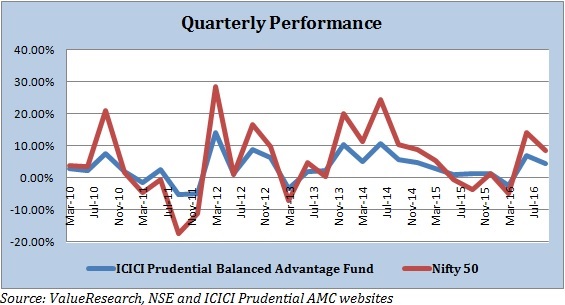

You can see the ICICI Prudential Balanced Advantage fund has not fallen as much as Nifty 50 in bad times. This is likely for all hybrid funds.
Risk and reward go hand in hand. Lower risk (volatility) may result in lower returns too. Therefore, you can expect dynamic asset allocation funds to under-perform equity funds when the equity markets are doing well.
I can do asset allocation myself. Why do I need dynamic allocation fund?
Yes, you can do that but you need to ask yourself. Do you have the skill and investment discipline to do asset allocation on a regular basis?
Don’t forget the costs. You will have to incur transaction cost and capital gains tax. If MF scheme does asset allocation for you, there is no capital gains tax liability. Transaction costs for the AMC are much lower than a retail investor would incur.
Who should consider investing in Dynamic Asset Allocation Funds?
A good dynamic asset allocation fund can be a good all-weather friend.
However, when equity markets do very well, such funds may under-perform pure equity funds.
Dynamic asset allocation funds, in my opinion, do not aim to provide you the best returns but provide you a stable market experience with good returns.
Many investors cannot stay in equity markets because they cannot digest volatility. For such investors, dynamic asset allocation funds can be very useful.
Similarly, many investors leave equity markets after suffering heavy losses. Such losses could be because they invested in pure equity products when the markets were high. Given the way asset allocation funds operate, asset allocation funds may be a good option for such investors too.
New investors can consider such hybrid funds as their first investment.
Even for existing investors, hybrid funds including dynamic asset allocation funds may form core of their equity portfolio.
For retirees, such asset allocation funds may be a good way of taking exposure to equity.
Do note you can incur loss in dynamic asset allocation funds too. However, given the way asset allocation funds work, the chances of a loss are lower than in a pure equity fund. Apart from the fund manager’s ability to pick good stocks, performance depends on the underlying asset allocation model of the scheme.
Do note merely investing in a dynamic asset allocation fund is not enough. You need to pick up the right fund too.
Even though every fund within the same category can be very different, dynamic asset allocation funds, owing to their underlying allocation model, can be even more different. Hence, it is extremely important to read the fund details in Scheme Information document before deciding to invest in such funds.
Disclaimer: Mutual Fund investments are subject to market risks, read all scheme related documents carefully