


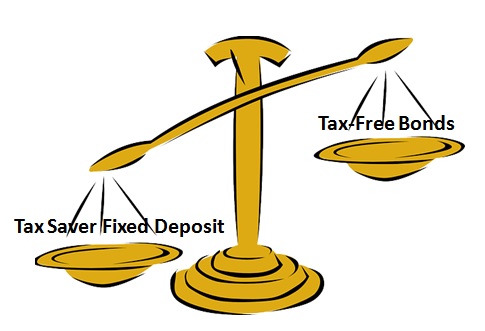
Tax-free bonds have been the flavor of the last financial year. There were many such bonds issues in the last fiscal. All the issues saw huge demand and were lapped up on the first day itself.
I have had my reservations about tax-free bonds but that’s not the topic of this post. From my interaction with the bog readers and clients, I could sense there was a minor confusion about these tax-free bonds. A number of them took tax-free bonds as an alternative to tax-saving bank fixed deposits, which offer tax deduction under Section 80C of the Income Tax Act.
I think it is apt that I dedicate an entire post to explaining the difference between tax-saving fixed deposits and tax-free bonds.
Must Read: All you need to know about Tax-Free Bonds
Tax Benefit on Investment
There is no tax benefit on investment in tax-free bonds under Section 80C of the Income Tax Act.
Investment in 5-year tax-saver fixed deposits up to Rs 1.5 lacs per financial year is eligible for tax deduction under Section 80C of the Income Tax Act.
Must Read: How to save Income Tax? (Section 80C)
Additional Read: Lesser known Income Tax Deductions
Tax on Interest Income
Interest Income from tax-free bonds is exempt from income tax.
Entire Interest income from tax saver fixed deposits is taxable at your marginal income tax rate (as per income tax slab).
Tax on Capital Gains
If you hold the tax-free bonds till maturity, there is no scope of capital gains. However, if you exit your holdings in the secondary market (stock exchanges), you may have capital gains tax liability.
Short term Capital gains (holding period <= 3 years) will be taxed at your marginal income tax rate.
Long Term Capital gains (holding period > 3 years) will be taxed at 10%. There is no benefit of indexation of listed tax-free bonds.
In case of tax-saving fixed deposits, there is no chance of capital gains and hence capital gains tax is not applicable.
Tax Deduction at Source
Since the interest income on tax-free bonds is exempt from tax, there is no question of TDS on interest income from tax-free bonds.
In case of tax-saving fixed deposits, TDS is deducted at 10% if the interest on fixed deposits (and not just tax-saving FDs) across all the branches of a particular bank exceeds Rs 10,000. If you have not submitted PAN, TDS will be deducted at 20%.
Please note deduction of TDS does not mean your income tax liability. If you fall in the higher tax bracket, you will have to pay additional tax. Alternatively, if excess tax has been deducted, you can claim it back at the time of filing income tax returns.
To understand, how TDS can impact returns on a fixed deposit, go through this post.
Must Read: Fixed Deposits vs. Debt Mutual Funds
Additional Read: How at save TDS on interest from Bank Fixed Deposits?
Liquidity
Technically, you can sell your holdings in tax-free bonds in the secondary market. However, the liquidity is low with daily volumes running into hundreds or couple of thousand bonds. But you do have to option to exit before maturity.
With tax-saving fixed deposits, there is no premature exit possible. You have to stay invested for full 5 years.
Maturity
Tax-free bonds are typically available with maturity of 10, 15 and 20 years. So, through tax-free bonds, you get an option to lock-in interest rate for the long term.
Tax-saving fixed deposits mature in 5 years.
Which is better? Tax-saving Fixed deposit or Tax-free bonds
To be honest, there is no need to compare. These products serve different purpose.
There is no need to invest in tax-saving bank fixed deposits unless you are investing for Section 80C tax deduction. If your Section 80C is already full, you can simply do with regular fixed deposits.
Since tax-free bonds do not offer tax benefit on investment and are much longer term products, there is no real need for comparison between the two products.
Tax-free bonds are apt for those in higher tax brackets and looking for regular income.
There may be a scenario when you still have Section 80C left unutilized and you have an ongoing tax-free bonds issue. You have money to invest in only one of them. What will you do? Let’s understand this with the help of an illustration.
You have Rs 1 lac to invest. You still have Rs 1 lacs limit unutilized in Section 80C basket. You are not comfortable with any other product in the Section 80C basket apart from bank fixed deposits. FD is available at 7.5% p.a. (payable annually) while tax-free bond is offering tax-free interest of 7.5% p.a. What would you do?


So, if you want to compare products solely on the basis of post-tax yields, don’t invest in tax-free bonds if you have your section 80C limit unutilized.
Recap


Image Credit: OpeClipArtVectors,2013. Modified. The original image and information about usage rights can be downloaded from Pixabay.