
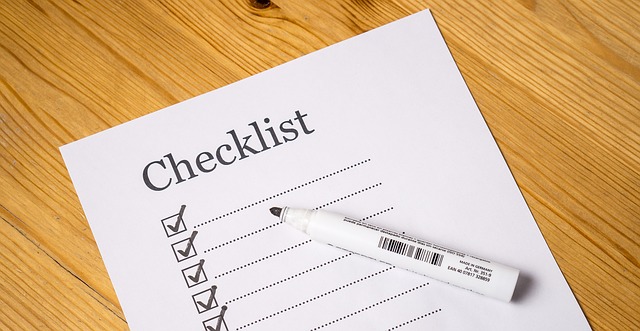
There are limits to human memory and attention and it is not difficult to miss basic steps in a task. Therefore, a checklist can be extremely useful. A checklist breaks down a complex task into a series of steps.
You can follow the steps as mentioned in the checklist (READ-DO checklist) or you can confirm that the steps mentioned in the checklist have been followed (DO-CONFIRM).
Recently, I read the book “The Checklist Manifesto” by Dr. Atul Gawande, a well-known US-based surgeon. Dr. Gawande showed how checklists have helped reduce infections, costs and save patient lives in something as complex as surgeries. He considered examples from industries as diverse as aviation, construction, hospitality, and investments where checklists have been able to add immense value. I recommend the book to the readers. Here is a TED talk by Dr. Gawande on The Importance of Checklists.
A checklist is not a new concept for us. I am sure all of us use such checklists in one form or the other.
We use checklists while packing or shopping. A food recipe is a checklist. When we ask kids every day if they are carrying a water bottle, lunch box, pencil box, and id card to the school, we are running through a checklist. We use a checklist at work all the time. In fact, there are big teams (Quality teams) in organizations to ensure that you have complied with the checklist for your work. And these teams have checklists to check if you have adhered to your checklists.
When I go out and am about to lock house doors, I feel for four items in my pockets: Mobile phone, House keys, wallet, and handkerchief. It is a checklist. By the way, I don’t go ticking items on a piece of paper. This is a mental checklist. If I must take the car, I add car keys and papers to the list.
A checklist is to ensure that you don’t make very basic mistakes. A checklist can tell you if you missed out on a basic step. A checklist can tell you to pause to think over/discuss before you move ahead.
A Financial Checklist
How many of us have rued a financial decision right after we made it? I am not talking about the uncertainty associated with any decision. It is more about: When you discuss your investment the next day with your colleague/friend, he points out 5 objective flaws with the product. Or the same realization when you google about the product the next day. When you try to undo the decision, you find out you can’t do that. You will lose all your money or incur a heavy penalty. You can only wish you had done some research.
In such cases, I think checklists can help you avoid basic mistakes and self-goals. A checklist can force you to think deeper and understand the product better before you make a choice.
With investments, our emotions can also play a big role. It is easy to buy into euphoria around a stock, an investment theme or an investment product. You are tempted to shun your investment discipline. A checklist can force you to think objectively or at least bring down the size of ill-advised bets. A checklist can help you stick to a process.
The best part with a financial checklist that you are not really pressed for time. Unlike surgeons or pilots, you don’t have to go through the checklist in a few seconds or minutes. You can take time. You can take hours and days to decide.
In this post, I will give you pointers for a financial checklist. It will read more as a pledge list than as a checklist. However, the intent is only to guide. For instance, “I will not more than 50% of my long-term portfolio in equities” means if “I am investing a certain amount, I must ensure that I do not cross that threshold.”
Take these points as a starting point and prepare your own checklist.
Thinking about insurance
- Do I have adequate life insurance? (Life Insurance + Existing Wealth should be enough to square off all the loans, provide for all the goals and say 30 years of expenses). So, if your savings are 20 lacs, loans are 45 lacs, you need Rs 25 lacs each for the education of two kids and Rs 50,000 per month of expenses, your life cover requirement is ~ Rs 2.5 crores.
- Do I have adequate health insurance? (At least Rs 5 lacs per person)
- Do I have adequate disability insurance? (Should be in line with life insurance)
- Do you have an adequate emergency fund? (At the least 6 months of expenses)
- Do you have an adequate medical fund? (say Rs 5 to 10 lacs)
While purchasing investment and insurance products
- I will purchase only pure insurance products.
- Does the investment product provide the dual benefit of insurance and investment? If yes, better to avoid.
- I won’t invest in say ULIPs and traditional insurance plans.
- In a ULIP, apart from the fund management charges (FMC), are there any other charges linked to the size of your investment? If yes, don’t invest.
- Are there any charges that reduce the portion of the premium that gets invested? If yes, better to avoid.
- Is the life cover less than 10 times the annual premium? In such a case, maturity proceeds won’t be exempt from tax.
- Does the product provide insurance on the life of the child? If yes, don’t buy.
While making investments
- I have closed expensive loans. If not, focus on closing them first.
- If an investment product offers more than a bank fixed deposit, it must carry some risk. I need to dig deeper. (Does not apply to investment products that are guaranteed by the Government).
- I will not invest the money needed in the next 5 years in equities. I will stick with fixed income products.
- My asset allocation is in place, say 50:50 equity:debt.
- I will not invest more than, say, 20% of my equity portfolio into direct equities. The rest must be in mutual funds.
- I will not invest more than, say, 30% of my equity portfolio in mid and small-cap stocks or mutual funds.
- I will not invest more than, say, 20% of my equity portfolio into sectoral/thematic funds.
- I will invest, say, 5%, of my long-term portfolio in gold.
- I will invest say, 15% of my long-term portfolio in international equities.
- I will rebalance my portfolio every year.
- No matter how attractive an investment opportunity sounds, I will not put more than, say, 1% of my wealth at one go in that opportunity.
- I will not invest in futures and options.
- Am I saving enough for all my goals, including retirement?
- Am I able to save say 30% of your monthly income?
While taking a loan
- Is not taking a loan an option? If yes, explore the options before you borrow.
- Can I repay this loan easily? If not, avoid it.
- Is the loan to make speculative investments, say stocks/futures/options/short term real estate purchases? If yes, don’t take the loan.
- Is the loan taken to create an asset (home/education etc) or for consumption (personal loan)? If the loan is for consumption, think again.
- If I take a secured loan (against gold/securities/property) and can’t repay, the bank will take the asset from me. If you doubt your repayment ability, it is better to sell the asset than take a loan against it.
- If the post-tax cost of your loan is higher than the post-tax return from your investments, sell your investments and prepay the loan.
- Will the loan payments affect my ability to invest for long-term goals? If yes, think again.
Succession
- Does your family know about your investments and insurance plans? (Prepare a list and share with the family).
- All your investments and insurance have nominations in place.
- Either educate your family about investments or find someone who can guide them in your absence or both.
- Prepare a will.
This is a hastily compiled list.
Confession: I have not complied with some of the items on the list.
I intend to revise the list on a regular basis. I will keep adding items to the checklist. At the same time, we need to ensure that the checklist doesn’t become too big to be any use. A checklist is no use if we don’t use it.
By the way, these are just the pointers for you to compile your own financial checklist. You can have a different checklist. You can add or remove items from the checklist mentioned above. You can customize the checklist for you.
If you like the post, do share with your friends and family.
If there is an item that you think I can add to the list or the pointers can be worded in a different way, do leave your suggestion in the comments section.
Image Credit: Pixabay







1 thought on “The Financial Checklist”
Hi Deepesh,
Thank you for the list. looks absolutely useful and a must for every earning household.
More than a checklist, it looked like commandments that you personally use.
The validity of which could be preceded with a Investment profiler before recommending something like
‘I won’t invest in say ULIPs and traditional insurance plans’ or ‘My asset allocation is in place, say 50:50 equity:debt’.
I just wanted to suggest that ULIPs and traditional plans do have their rightful place for certain segments of people. as in what instruments are available that are really cost effective in the long term says 10-15 years or what instruments can pay for itself when one can’t for disability or illness?
i do like your point on ‘Do I have adequate disability insurance? (Should be in line with life insurance)’
Best Rgds,